







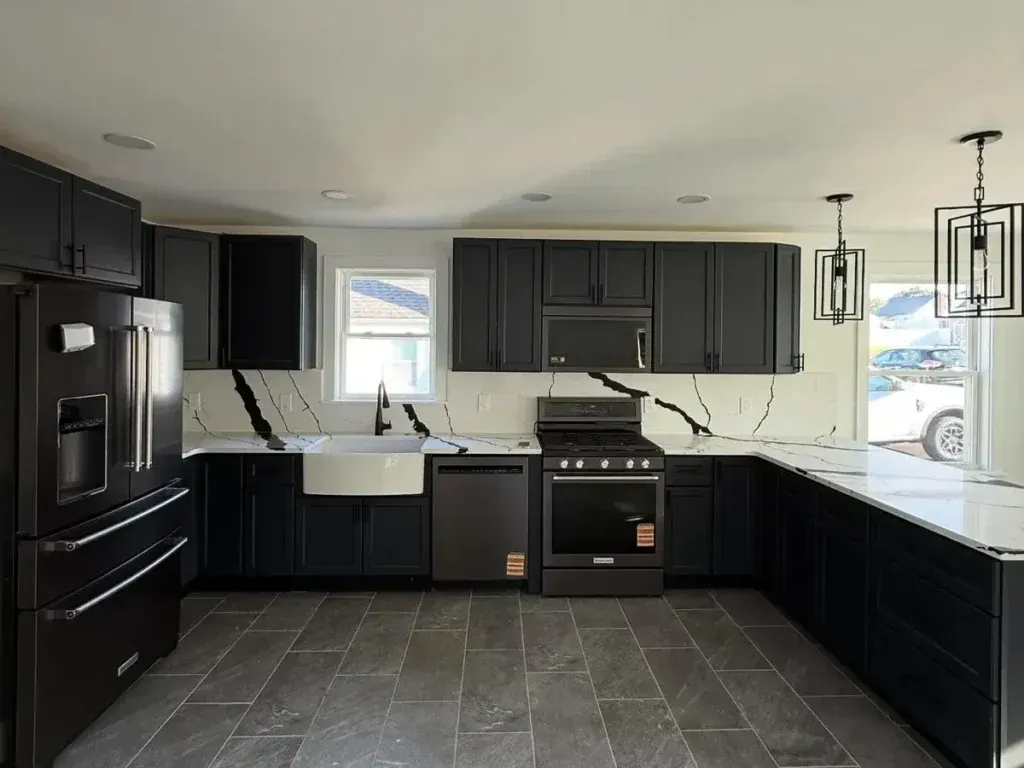
What Is the Best Thickness for a Kitchen Countertop?
For most kitchens, 3cm (about 1 1/4 inches) is the right thickness for a quartz or granite countertop. A 2cm slab (about 3/4 inch) works in some cases, but it needs extra support. Our kitchen countertop installation team in Philadelphia installs both, and this guide shows how to pick.
Thickness changes how the counter looks, how it handles weight, and what it costs to install. It also decides which edge styles you can have. Below you will find the common sizes for each material, how edges can fake a thicker look, and what to ask before you sign.
How Thick Is a Standard Kitchen Countertop?
A standard kitchen countertop is 3cm thick if it is quartz or granite. Stone and quartz slabs are sold in the trade in centimeters, not inches. That is why you hear “2cm” and “3cm” so often.
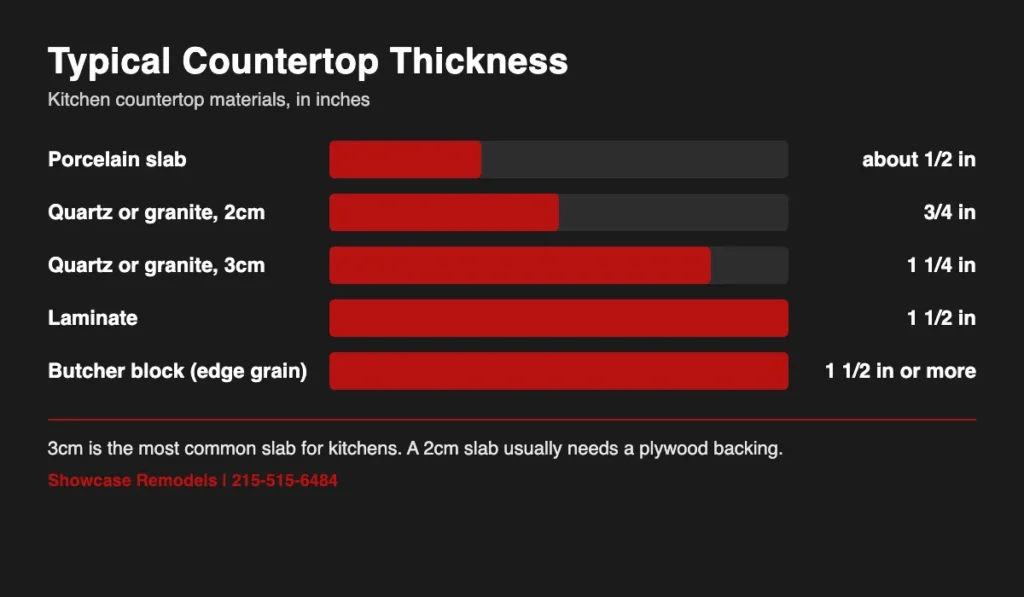
A 2cm slab is about 3/4 inch. A 3cm slab is about 1 1/4 inches. MSI Surfaces notes that a 3cm slab handles heavier weight. It is the better pick for spaces with heavy use.
Why 3cm became the norm
A thicker slab is stronger across the span between cabinets. It is also less likely to chip at an exposed edge. Fabricators can make most edge profiles in 3cm, including the bolder ones.
When 2cm still makes sense
A 2cm slab weighs less and costs a little less in material. It can work on a vertical surface like a backsplash. It can also work on a short run of cabinets where it has support all the way across.
Thickness also changes weight. A 3cm slab is heavier, so the cabinets under it must be solid and level. Before we install, we check the cabinet boxes. Sagging or damaged cabinets are a good reason to fix them first.
There is a catch. A 2cm counter on a longer run usually needs a plywood base under it, according to Hunker. The plywood adds a step and a cost, and the savings can disappear.
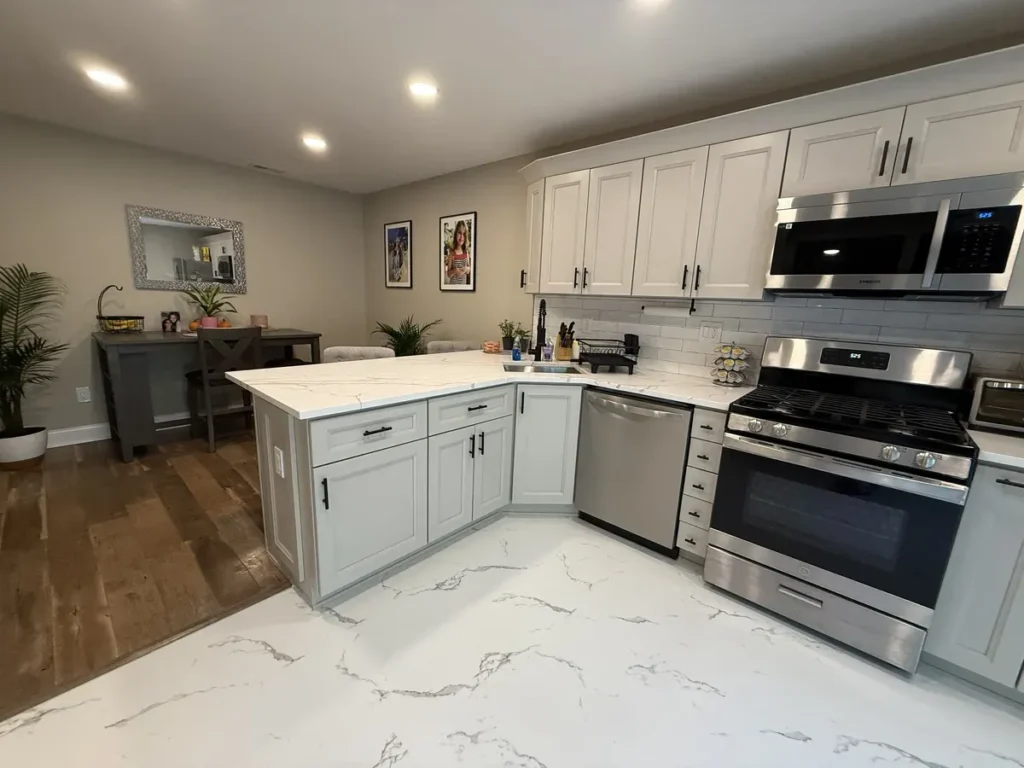
How Thick Is Each Countertop Material?
Each material has its own typical thickness. The chart above shows the common sizes side by side.
Thickness does not tell you quality. A thin porcelain slab can be very hard, and a thick laminate counter can still scratch. Pick the material first, based on heat, stains, and daily cutting. Then pick the thickness.
Quartz and granite
Both come in 2cm and 3cm. Most homeowners choose 3cm. It is the safer pick for a kitchen with a sink cutout, a cooktop, or a busy family.
Laminate
Laminate counters are usually 1 1/2 inches thick. They look thick because the laminate sits on top of a built-up base, not because it is solid.
Butcher block
Edge-grain butcher block starts at about 1 1/2 inches. End-grain blocks run thicker. Wood is a good fit for an island or prep area.
Porcelain
Porcelain slabs are thinner, often about 1/2 inch. Many are bonded to a base or built up at the edge. Ask your installer how the edge will be made.
Thicknesses vary by brand, so always check the exact product. For help on materials, read our guide on quartz vs granite countertops.
What Do Philadelphia Kitchens Need From a Countertop?
Many Philadelphia homes are rowhomes and older twins with compact kitchens. Cabinets are often not perfectly level, and runs are short. That makes exact measuring more important than the slab size on the sales sheet.
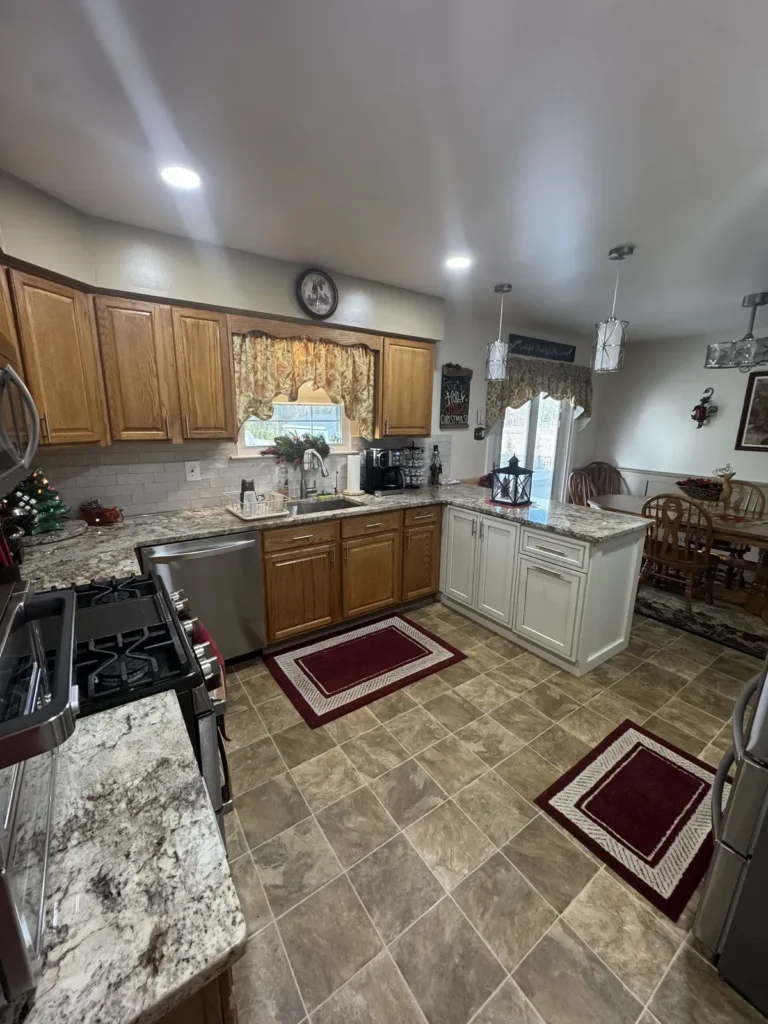
On our Mayfair kitchen remodel, Donna’s old countertops were worn and the cabinets were a mix of styles from past owners. We replaced the counters with granite and updated the cabinetry. Our project manager Santo ran the kitchen from start to finish.
On jobs like this, we start with a digital template of the cabinets. Our templates are accurate to within 1/16 of an inch. The slab is cut to that template, so the fit is tight and the seams stay small.
The same goes for a peninsula or island with bar seating, like the one in our quartz island kitchen renovation. Seating needs an overhang. MSI Surfaces says a thinner slab with a bar-stool overhang may need plywood or other reinforcement. Plan the seating before you pick the thickness.
How Do You Choose the Right Countertop Thickness?
Start with your cabinets and your layout. Then match the slab to how you cook and live in the kitchen.
Choose 3cm if
You want the most durable counter. You have a long run, a sink cutout, or an island with seating. You want a bold edge such as a mitered or waterfall edge.
Consider 2cm if
You like a slim, modern look. The run is short and fully supported. Your installer will add a plywood base, and you have priced it in.
Ask about the edge
A thick-looking edge can be built by adding stone around the perimeter. The slab stays 2cm or 3cm, but the front looks chunky. Ask to see a sample of the exact edge.
Compare prices the right way
The price gap between 2cm and 3cm slabs is often small. Labor, sink cutouts, edges, and any plywood base can matter more. Ask for both quotes in writing, with the same color and the same edge.
Counters also have to work with the rest of the room. If you are changing the floor too, read how to replace kitchen flooring without removing cabinets. If you are picking pulls, see our guide to choosing kitchen cabinet hardware. If you are not sure what to do first, here is whether to replace countertops or cabinets first.
When you are ready, we measure, fabricate, and install. A pro can also tell you if your cabinets can carry a heavier slab.
Frequently Asked Questions
For most kitchens, 3cm is better. It is stronger, handles more edge styles, and does not need a plywood base. A 2cm slab can work on short, fully supported runs or as a backsplash.
Granite countertops are usually 2cm or 3cm thick. Most fabricators default to 3cm, which is about 1 1/4 inches. Ask your fabricator which one they quote by default.
Ask for a built-up or mitered edge. The fabricator adds stone around the perimeter so the front looks thicker, even though the slab is still 2cm or 3cm. A waterfall edge on an island gives a similar look.
Ready to Pick Your Kitchen Countertops?
Showcase Remodels measures, fabricates, and installs kitchen countertops across Philadelphia, PA. Call us for a free design consultation and a price on the thickness that fits your kitchen.
